Use These 10 Literary Devices to Tell an Awesome StoryIf you're writing a book, screenplay, or short story, you want to captivate your audience with your characters and settings, build suspense, and deliver strong emotional payoffs. Literary devices are tools that can help. Though plenty of literary devices exist, these 10 are particularly useful in fiction and narrative non-fiction. Check out these examples and tips for using them to tell an awesome story.  Want to write an awesome story? Download my FREE outlining guide. What is a literary device?A literary device is a technique writers can use to make stories more engaging. These tactics can create suspense, evoke emotion, set up a plot twist, and more. Alliteration, symbolism, and foreshadowing are examples of literary devices. 10 literary devices for your storyBelow are definitions of 10 powerful literary devices for your book, screenplay, or short story. Click the "Learn More" links to see examples of each literary device and tips for applying it to your story. #1 - SymbolismSymbolism is when an element of your story - like a character, setting, or object - represents an idea. The represented idea tends to play a significant role in the story's character development, plot, or theme. For instance, in a prison story, grass might be a symbol for freedom. Learn More #2 - ToneTone is the attitude a writer takes toward the events in a story. Though characters may have distinct attitudes, the literary device tone just refers to the attitude of the writer. Some examples of tone are optimistic, comedic, and regretful. Learn More #3 - MoodMood is the overall feeling of a scene. Chaotic, warm, and sad are examples of moods. One story can have many moods, since different scenes can create different emotional responses from an audience. Learn More #4 - ImageryImagery is a literary device writers use to connect with any of the audience's five senses: sight, sound, smell, touch, and taste. Imagery is often used in the descriptions of characters, settings, and plot events. Learn More #5 - MetaphorA metaphor falsely asserts that one thing is another while creating a true, symbolic comparison. "The office is an igloo" is an example of a metaphor. Learn More #6 - PersonificationPersonification is the granting of human qualities to non-human elements in a story, like vehicles, houses, and even concepts, such as hope or doubt. Learn More #7 - ForeshadowingForeshadowing is a literary device writers use to allude to future events in a story. Two kinds exist: (1) Direct foreshadowing states a story event is to come (2) Indirect foreshadowing gives evidence of an event the audience does not anticipate. Learn More #8 - Dramatic ironyDramatic irony is a literary device in which a writer gives information to the audience that a character, or multiple characters, is unaware of. The tactic can build suspense. Learn More #9 - MotifA motif is a repeating element in a story that plays a strong role in the story's theme. Motifs can be abstract ideas, like triumph or deceit. They can also be parts of your story's physical world, such as buildings, objects, colors, and noises. Learn More #10 - AlliterationAlliteration is the repetition of a consonant sound at the start of two or more close-together words, as in "warm weather," with "w" the repeating sound. Learn More 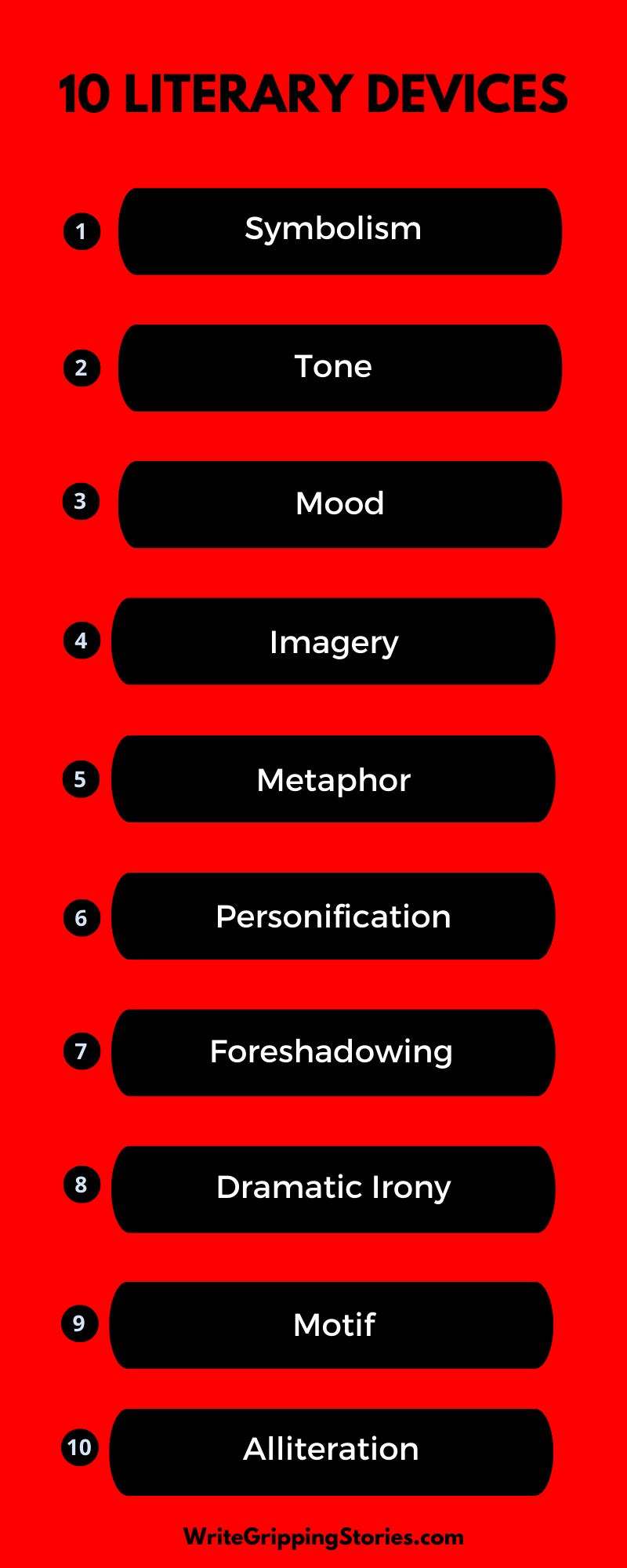 Why use literary devices?Here are just some storytelling components literary devices can help you with:
What genres use literary devices?Literary devices are used across fiction and narrative non-fiction. Some examples of genres that use literary devices:
How to use literary devicesLiterary devices should serve the story you're telling. Once you have an idea of your characters and your plot, and you begin writing your first draft, you'll need to accomplish various tasks to make any scene work. For instance, let's say your main character in a thriller is running from three gunmen in a scene. For this scene to work, a task of yours could be making the audience fear for your protagonist's life. A combination of literary devices can be applied to accomplish that task. You can use dramatic irony to make your protagonist unaware of the danger lurking around the corner. Once the protagonist sees the gunmen, you can leverage mood to create a feeling of desperation. You can also apply imagery to show the physical effects of panic, like sweat and an accelerating heartbeat. Think of literary devices like specialized tools. Let your story tasks dictate when and how you apply these tools. What to avoid when using literary devicesAs stated, the writing tasks you need to accomplish to make a scene work should determine what literary devices you use - avoid the opposite approach, ie, deciding you want to use a certain literary device and then bending the purpose of a scene just so the device can fit. You also want to avoid literary devices drawing attention to themselves. They should help your scenes flow, not cause the audience to focus on the device. Certain devices, like alliteration, can draw attention to themselves if used too often. Other devices, like tone, can draw attention to themselves if shifted through a story. Once you gain a deeper understanding of the 10 literary devices outlined above (with the "Learn More" links), you should have a good idea of how to apply them to your story in a natural way. 
0 Comments
Captivate Your Readers With Imagery: Definition, Examples, and TipsIf you're writing a book, screenplay, or short story, you want to draw your readers deep into the world of your story. Imagery is a powerful literary device you can use to give your readers a vivid experience of your scenes. In this article, I provide the definition of imagery, examples, and tips for applying it in your story.  Want to write an awesome story? Download my FREE outlining guide. What is imagery in writing?Imagery is a literary device in which writers engage readers via language that evokes any of the five senses: sight, sound, smell, touch, and taste. Imagery is often applied to the descriptions of characters, settings, and plot events. Why is imagery important?Imagery is a literary device that creates a sensory connection between the reader and the physical world of the story. Scenes become more immersive because of this connection. After a reader finishes a scene, an effective use of imagery can make him say, "I felt like I was there." The writing technique can also build empathy with characters, a key part of storytelling. If a reader is able to sense what a character is experiencing, the reader can better empathize with that character. Below are two examples of a plot event, the first described without an emphasis on imagery, and the second with an emphasis on it. Which do you feel is stronger? Example A Becca walks through the woods to meet her friends at the campsite. She believes a killer is following her, so she takes off running. She runs for about a mile, reaches a street in a small town, and hides out in a diner. Example B Becca walks through a dark forest toward the campsite. Footsteps thud behind her. She looks over her shoulder, but sees nothing but the gnarled barks of trees. She heard a rumor about some weirdo who lives out here, but figured it was just an urban legend. She keeps walking, the November air cold on her neck. The footsteps behind her return. She takes off running through the close-together trees. Her heart pounds. The branch of a pine tree hits her in the face. She spits a few pine needles out of her mouth. Up ahead, the lights of a small town glisten beyond the evergreens. She dashes onto the street and rushes into the first building she sees, a diner. The place smells like apple pie. However, Becca is too nervous to eat. Shaking and huffing, she sinks onto a stool at the counter. The 5 types of imagery in writingThough the word imagery relates to sight, as a writing technique, imagery does not just apply to the visual - it relates to all five senses. Below are examples of the five types of imagery in writing: Visual imageryWith visual imagery, a writer uses language that lets readers imagine specific images. For example: Over the silhouette of the mountaintops, a bolt of lightning rips through the sky. The rain, coming down at a sideways angle, smashes the body of Bill's car. Sound imageryWith sound imagery, a writer uses language that lets readers imagine specific sounds. For example: Nick swings the crowbar into the department store's window. The glass shatters. Shards shower down on the pavement at his feet. He runs inside while the alarm wails. Scent imageryWith scent imagery, a writer uses language that lets readers imagine specific scents. For example: Kayla looks away from the TV. She sniffs the air. It smells like burnt wood. She swings open her bedroom door. The scent grows stronger. She notices smoke. Taste imageryWith taste imagery, a writer uses language that lets readers imagine specific tastes. For example: Gary watches the waiter carry over the entrees at his favorite restaurant, Forge Steakhouse. He grabs his fork and knife and looks down at the twenty-four-ounce porterhouse set in front of him. He slices off a piece. It warms his entire mouth. He bites into it, the juice seeping out. Tactile imageryWith tactile imagery, a writer uses language that lets readers imagine specific sensations of touch. For example: The bullet tears through Scott's thigh. The hot metal shreds his muscle. His entire leg flames with pain. Tips for applying imagery in your writingImagery can enhance almost any scene. However, you need to be careful about when and how to apply it. Here are some tips to follow: #1 Avoid excessive adjective useImagery is a type of descriptive writing. When trying to be descriptive, some writers make the mistake of loading their sentences with adjectives. Feel free to use adjectives in your imagery, but don't overdo it. A combination of vivid nouns and verbs can often make a point stronger, and in fewer words, than a series of adjectives. #2 Use more imagery for more important story elementsImportant characters, settings, and plot events warrant more detailed descriptions - and thus, more imagery. When you describe a setting that will go on to play a major role in your story, feel free to go into detail about it. For instance, let's say you're telling a crime story and the villain and his crew often hang out at his auto body. The place will later serve as the setting for the climactic shootout. You should go into specifics about things like the sounds of the mechanics' machines, the splotches of grease on the floor, the taste of the candy in the vending machine out in the hallway. In the same story, your protagonist happens to stop at a coffee shop. The shop is only in one scene, just briefly. Spending five paragraphs describing the coffee shop wouldn't be warranted - the setting isn't important enough to the overall story. #3 Vary the types of imageryGiving the reader a visual sense of a scene is critical. Thus, you'll likely find yourself using visual imagery more than the other kinds. That's okay. However, be sure to work in the four other types. That being said, you never want imagery to feel forced. Let's say you've used all the types of imagery in a certain scene except taste. If the scene doesn't call for a character to be tasting something, don't worry about getting in taste imagery. You should never create additional imagery at the risk of your story events feeling unnatural. What genres use imagery?Imagery is used across fiction and narrative non-fiction. Some examples of genres that use imagery:
Want more writing advice?First Person vs Third Person POV - Your Unique Writer VoiceA unique writer voice can make your book or screenplay stand out. However, to create a compelling, consistent voice through your story, you need to understand the nuances of point of view (POV), particularly first person vs. third person.  Want to write an awesome story? Download my FREE outlining guide. What is a writing voice?A writing voice is the tone a writer uses to tell a story. Though characters can have their own voices, the writing voice refers to the overall voice telling a story. With first-person POV, the voice is that of a specific character. In many other cases, it belongs to no character. Voice is important because it plays a key factor in the style of a story. Is a story told in a sarcastic way that pokes fun at the characters? Or, is that story told in a matter-of-fact fashion that gives the reader information without any direct opinion? These are two drastically different examples that would drastically alter the story's style. If you're trying to capture a certain style, you need to be mindful of voice. And that means you need to be mindful of POV... What is a writing POV?A POV is the perspective a story is told from. The two main options are first person and third. In first, the story unfolds from the perspective of a character, who speaks with "I." In third, various characters can be the subjects of specific scenes, yet they are referred to by name, not "I." POV is important because it helps define voice and style, but also because it plays a major role in how information is delivered to your reader. When writing from the perspective of a subject character, you can only discuss information that character would be aware of - in a given scene, the reader can only know as much as this character. Because of the various nuances associated with POV - which we'll discuss later in this post - writers often make POV mistakes. Unfortunately, these can make you come off as an amateur. As I went over in my post on dialogue writing, publishing-company employees, film producers, and consumers will often only read five or so pages of your story before making a decision to continue or not. If you have a POV error on those opening pages, you'd be giving someone a reason to stop reading. What are the types of POV in writing?As mentioned, the two major POV categories are first person and third. However, within third are various distinctions. The four key POVs:
If you're writing a book, you can choose any of these four POVs. Once you pick one, you need to stick with it through your story, though. Thus, be sure to select the one that'll let you tell your story in the most impactful way. If you're writing a screenplay, you don't have any choice about POV. Scripts tend to be written in third-person omniscient. Below, find a detailed breakdown of the four key POVs. 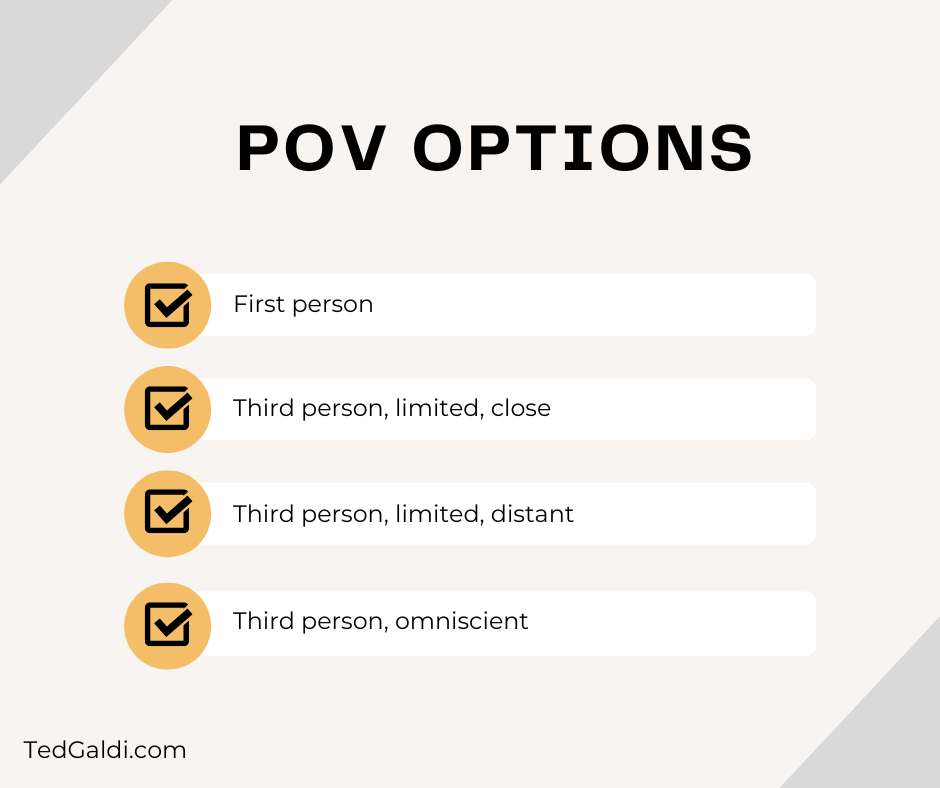 What is first-person POV?
What is third-person, limited, close POV?
What is third-person, limited, distant POV?
What is third-person, omniscient POV?
Leveraging POV for a distinct writing voiceAs mentioned, with first-person POV, your story's overall voice becomes that of the protagonist. With third-person POV, however, the overall voice is fused together by various factor, such as:
Get more writing tips with my free guide You might also like my posts on descriptive writing and characterization.
|
 RSS Feed